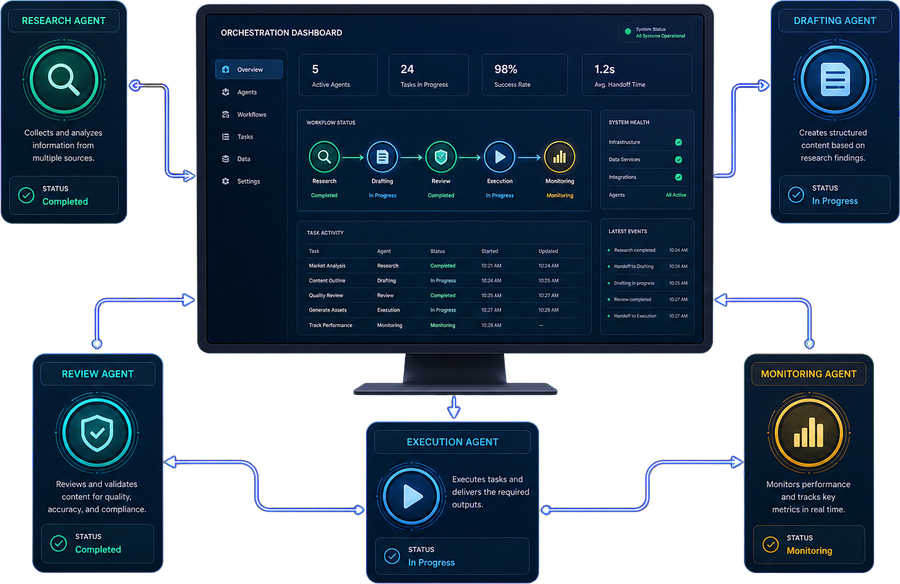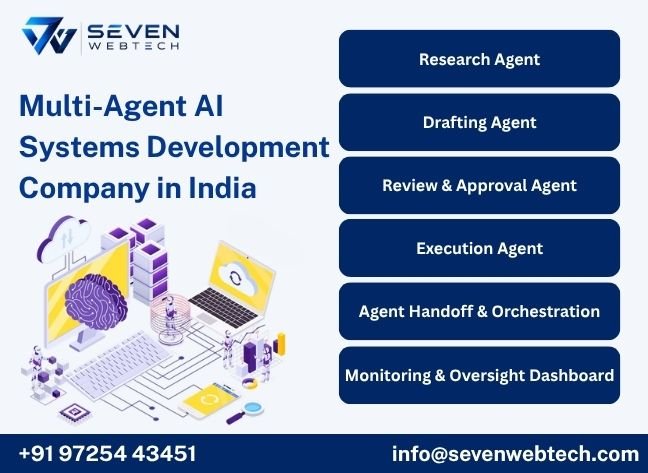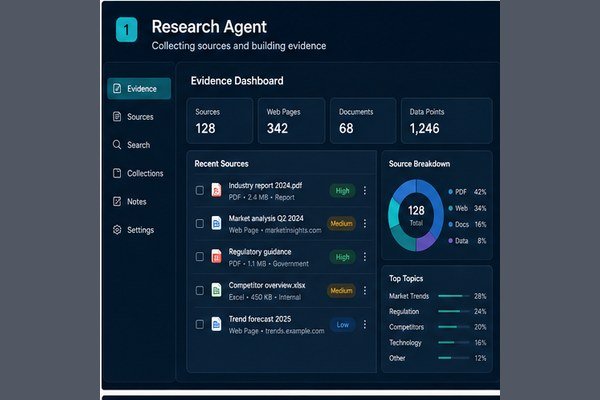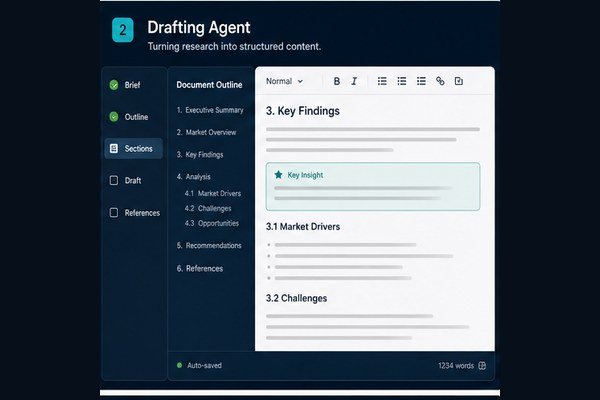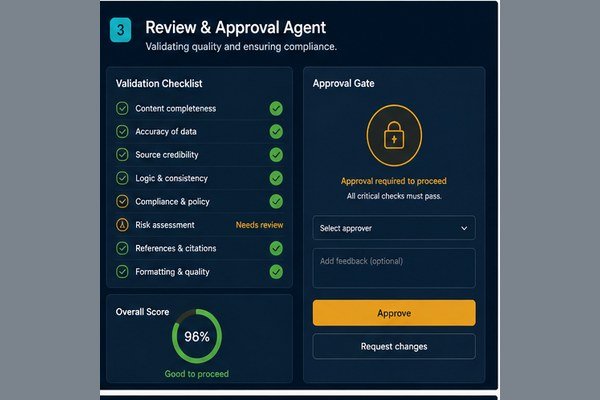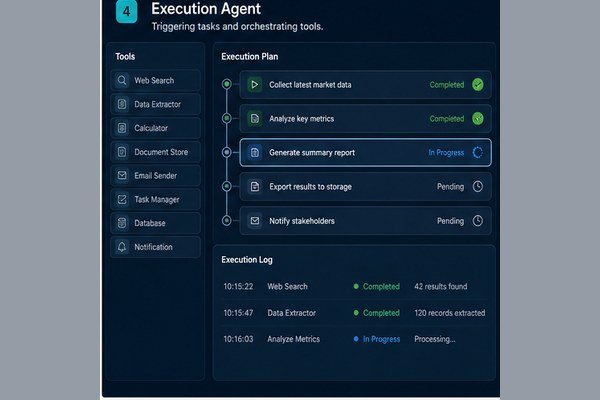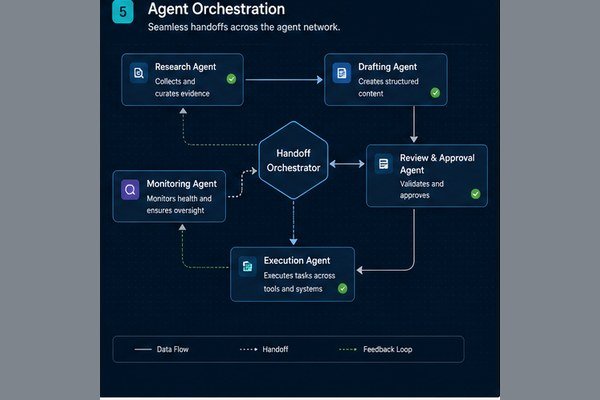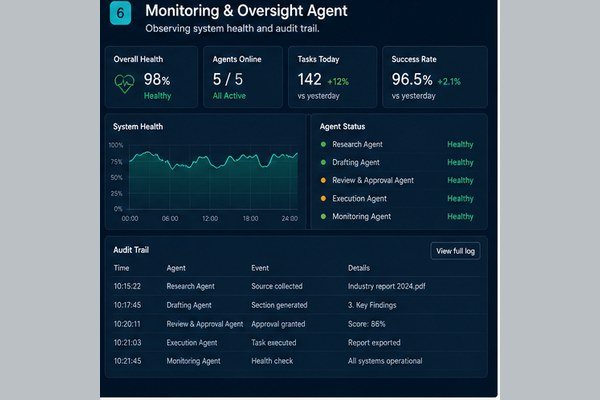
One agent can only do so much on its own. For processes with real stages - research, drafting, approval, execution - we build a set of specialised agents that each handle one part well and pass work to the next, with a clear record of what happened at every step. Think of it as a small digital team where each member has one job and does it properly, instead of one agent trying to do everything at once.

A single agent handling everything from research to final output tends to get shaky the moment the process has more than two or three stages - it either does a mediocre job at each stage or needs constant supervision. We split the work instead. One agent researches, another drafts, another checks the output against your rules, and a fourth executes the final step, with each one built and tested for its specific job. The handoffs between them are the part most teams get wrong, so we spend real effort making sure information passes cleanly from one agent to the next.
We've built backend systems for Indian businesses for close to two decades, which means we're comfortable with the unglamorous parts of multi-agent work - logging, retries, what happens when one agent fails mid-process. That groundwork matters more than the AI model you pick. A multi-agent system without proper coordination and error handling breaks in ways that are hard to trace, and we design against that from day one.
As your process grows - more document types, more approval stages, more downstream systems - we add agents to the pipeline rather than rebuilding the whole system. Each agent stays narrow and well-tested, so the overall system stays reliable even as it takes on more responsibility over time.
We've built multi-step backend systems for Indian businesses for close to two decades, and that experience with reliable handoffs carries directly into how we design agent pipelines.
We don't cram one agent with too many jobs. We break your process into stages first and design a specialised agent for each one.
A multi-agent system that handles a full process end to end saves more hours than a single agent bolted onto one step, and we design for that bigger outcome.
We help growing teams start with a two or three-agent pipeline for their biggest bottleneck, then add more agents as the process and the team grow.
We keep refining how agents hand work to each other, because the coordination layer is usually where a multi-agent system improves the most over time.
Our team follows a step-by-step process to design and build your multi-agent AI system. Here's the process

We start by understanding the full process you want handled, from the first stage to the final output.
We break the process into stages, decide how many agents you need, and map exactly what gets passed between them.
We build each agent for its specific job and design the coordination layer that manages handoffs between them.
We test the full pipeline together, including what happens when one agent's output isn't good enough to pass forward.
We launch the system on real cases and watch the handoffs closely during the first batch of live runs.
We look at where agents disagree or where handoffs slow down, and tighten the logic at those specific points.
We stay on to adjust individual agents or add new stages to the pipeline as your process changes.
Learn about all the reasons why you should choose Seven Web Tech as your multi-agent AI systems development company in India
Each agent in the system is built for one job, tested for that job, and connected into a pipeline that mirrors your actual process.
Every agent in the pipeline only accesses the data it needs for its stage, with clear boundaries between what each one can touch.
We put real effort into how agents pass work between each other, because that's usually where multi-agent systems break down.
You can see what each agent decided at every stage, which matters when a business process needs to be explainable.
We scope pricing around the number of stages and agents your process actually needs, not a fixed package that doesn't fit.
We stay available to fix issues, retrain individual agents or extend the pipeline as your process changes.
If you have an issue or question that requires immediate assistance, you can click the button below to chat live with a Customer Service representative.
We usually respond to new multi-agent system enquiries within a few business hours.
A single agent handling research, drafting, review and execution tends to do all four jobs adequately instead of any one job well, and it gets harder to fix when something goes wrong. Splitting the work across specialised agents means each one can be built and tested properly for its specific task, and you can pinpoint exactly where a problem happened.
We build a coordination layer that passes structured information - the research findings, the draft, the approval status - from one agent to the next, along with a record of what happened at each stage. It's not a loose chain of separate tools; it's designed as one system with clear rules about what gets handed off and when.
We build error handling into every stage, so a failed or low-confidence result doesn't just get passed forward silently. Depending on the stage, the system either retries, flags it for a person to check, or halts that specific case while the rest of the pipeline keeps working normally.
You decide where human review sits. Most businesses want a person to approve output before the execution agent acts on it, at least in the beginning. We build the review step in from the start and can loosen it later once you're confident in the system.
It depends on how many stages and agents are involved. A two or three-agent pipeline for one clear process usually takes a few weeks. Larger systems with more stages, more integrations or more approval logic take longer, and we give you a realistic timeline once we've mapped the process.
No. Your team interacts with the output - the draft, the report, the approval request - through the tools they already use. We handle the technical operation of the agents and stay on for support and adjustments.
Not necessarily - it depends on whether your process has distinct stages, not how big the company is. If a task genuinely moves through research, drafting and approval today with people doing each part, a multi-agent system can replace that chain. If it's really one simple task, a single agent is usually the better and cheaper fit, and we'll tell you that upfront.